
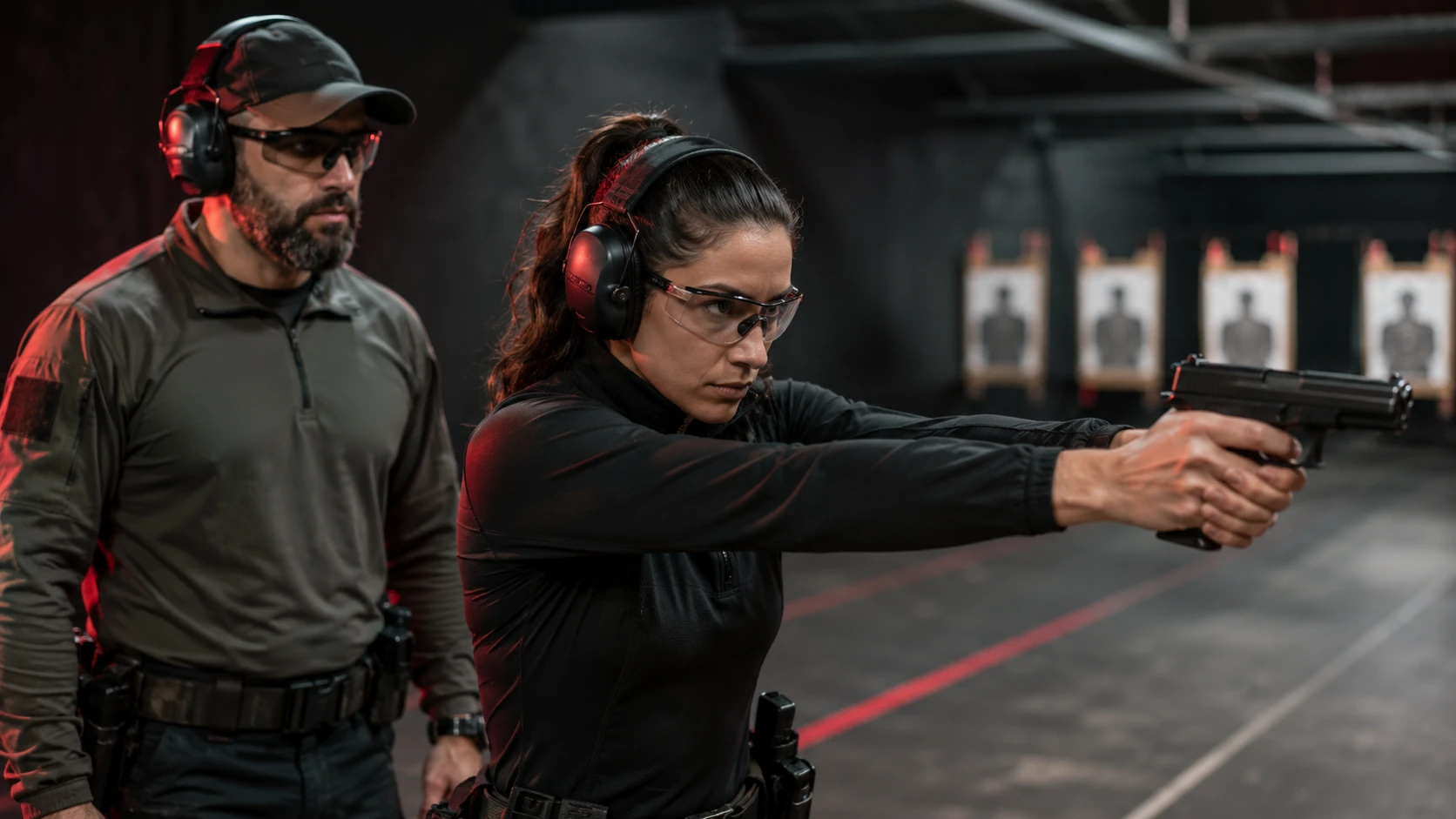
Maintaining and Improving Firearms Handling and Tactical Skills
How to progress from fundamentals to skills-builder and tactical courses without losing safe, reliable firearm-handling habits.
Firearms handling is a perishable skill. Accuracy, safe manipulation, speed and tactical application all depend on regular, deliberate practice. Completing a course provides knowledge and coached repetitions, but the ability must be revisited and maintained.
The original article explained the complete BZ Academy progression: begin with fundamentals, repeat them when necessary, move to a skills-builder course, progress to vehicle and close-quarter material only when the foundation is strong, and use private training to solve individual weaknesses.
This expanded version preserves every stage of that pathway and explains why experienced shooters and BZ Academy instructors continue returning to basic work.
- Complete beginners should start with a fundamentals course rather than selecting advanced tactical content.
- Different students learn at different speeds; repeating a course is normal and often valuable.
- Skills-builder training assumes safe manipulation and adds positions, reloads, transitions, distance and movement.
- Vehicle CQB and other tactical courses require strong fundamentals because the environment is tighter and more complex.
- Private one-to-one training can focus the available time on the exact skills the student needs.
Which course should begin the training journey?
For a complete beginner, BZ Academy normally recommends the Combined Firearms Course - Marksmanship Fundamentals or an appropriate tactical handgun or tactical rifle fundamentals course. The objective is to learn safe handling before speed or complexity is introduced.
The foundation includes safety rules, range commands, loading and unloading, safety checks, stance, grip, sight use, trigger manipulation, recoil management and follow-through. Students also begin to understand the controls and characteristics of the firearm platform.
People absorb information at different rates. One student may feel comfortable after the first day while another needs more dry practice and individual correction. Neither response is unusual. The correct pace is the one that produces safe, repeatable performance.
Why experienced students return to fundamentals
A course contains far more information than most people can apply immediately. After returning home, some points become clear only during later practice. Repeating the fundamentals course allows the student to hear the explanations again with better context and receive corrections on habits that developed in the meantime.
Many BZ Academy trainees repeat the same programme more than once and return several times a year. Some do it because they enjoy the training, but the main performance reason is that repetition prevents knowledge and proficiency from fading.
A strong shooter does not outgrow safe loading, unloading, muzzle discipline or trigger control. Those tasks become the reliable base that makes more demanding work possible.
Moving into Combined Firearms Skills Builder
The skills-builder course is designed for students who already have safe handling and stable fundamentals. There is not enough time to reteach every basic point, because the programme is intended to build on top of the existing foundation.
Training may include alternative shooting positions, emergency and tactical reloads, weapon transitions, engagement at varied distances, movement, malfunction management and an introduction to close-quarter work. Each new layer increases the amount of information the student must manage at the same time.
After the course, students should take time to digest the material. Repeating the programme later is often more productive than immediately attempting another advanced course without consolidating the new skills.
Progressing into vehicle and close-quarter training
Vehicle Close Quarters Battle introduces work in and around a vehicle, where space is restricted and muzzle management becomes more demanding. Students may work from seats, doors, pillars and different sides of the vehicle while coordinating movement and communication.
The environment is technical and immersive. The firearm must be controlled around people, glass, metal, doors and changing lines of fire. This is why previous experience and strong fundamentals are required before attending.
The same principle applies to room-entry and other CQB courses. Tactical content is not a shortcut around marksmanship. It adds decision-making, movement and spatial problems to the manipulation skills already learned.
Why course completion does not create an expert
Completing every course does not automatically make someone a perfect shooter. Firearms performance develops in the same way as other demanding physical and technical skills: through regular practice, coaching, reflection and correction.
Unstructured repetition can reinforce mistakes. A useful training session has a clear objective, measurable standard and a safe progression. Dry practice may be appropriate for presentation and manipulation, while live fire confirms recoil control, accuracy and timing.
BZ Academy instructors also continue training. They attend courses, travel, observe other professionals and revisit their own fundamentals. An instructor who stops learning eventually teaches from memory rather than current, tested experience.
- Choose one or two measurable goals for each practice session.
- Begin with safe, accurate repetitions before increasing speed.
- Record the drill, distance, target, time and result when possible.
- Stop and correct a recurring error rather than repeating it at full speed.
- Schedule periodic coached sessions so an instructor can identify habits you may not notice.
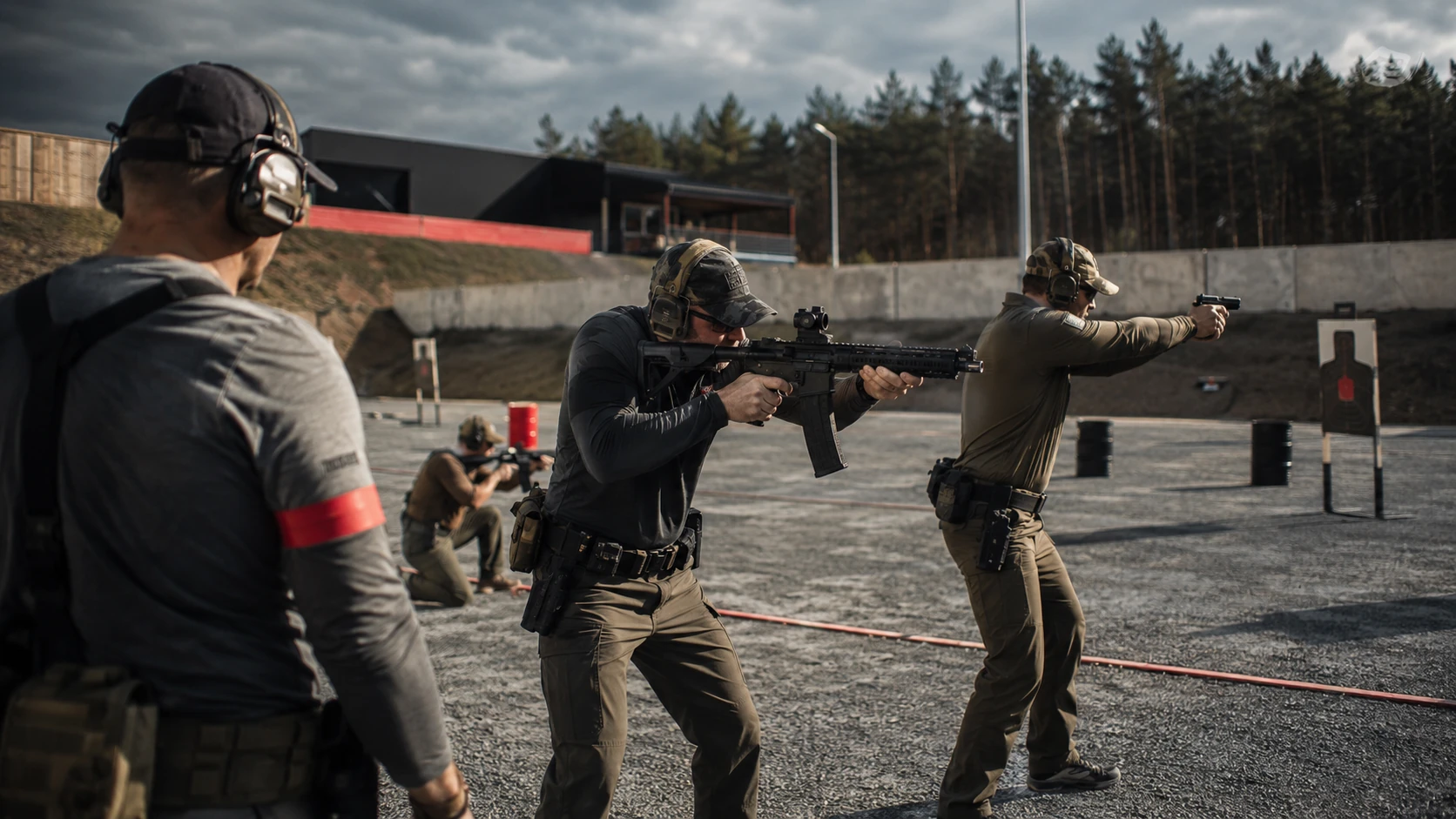
Private one-to-one training as a faster route to improvement
Private training allows the instructor to tailor the session to the experience, objectives and physical needs of one student. Time is not divided between a group, and drills can be repeated or changed as soon as a specific issue appears.
BZ Academy can provide private training with Glock pistols, AR-15 and AK-47 rifles. The content can remain at basic fundamentals, move into intermediate shooting or focus on tactical subjects when the student meets the prerequisites.
One-to-one work is also useful for a student returning after a long break, preparing for a course, testing unfamiliar equipment or correcting a problem with grip, presentation, reloads or accuracy.
Basic, intermediate and tactical private training
Basic fundamentals training covers safe handling, loading and unloading, aiming, stance, grip, sight alignment, trigger manipulation, breathing, maintenance and the correct use of the firearm.
Intermediate training develops shooting from different positions, movement, varied distances, faster manipulations and more demanding accuracy standards.
Tactical training can include VCQB, CQB, concealed-carry concepts and work from cover when the student has the legal basis, experience and safe handling required for the subject.
The advantage is not simply greater difficulty. The session can stay on the exact skill that needs work until the student understands and performs it correctly.
How to plan long-term development
- Learn the fundamentals. Complete a suitable introductory course and understand the safety standard.
- Practise deliberately. Use short, focused sessions rather than only firing large quantities of ammunition.
- Repeat the foundation. Return to a fundamentals course when confidence or consistency drops.
- Add one layer at a time. Move into skills-builder material before attempting complex tactical environments.
- Use private coaching. Ask an instructor to diagnose specific weaknesses and create a practice plan.
- Maintain the skill. Revisit training throughout the year instead of relying on a single annual course.
The strongest shooters keep returning to the basics
Progress is not a straight line from beginner to advanced. It is a cycle of learning, practice, assessment and return to the foundation. Every advanced skill depends on safe, efficient manipulation under simpler conditions.
Choose the course that matches your current ability, repeat important programmes and use private training when you need focused development. The goal is not to collect course names; it is to become safer, more accurate and more consistent.