
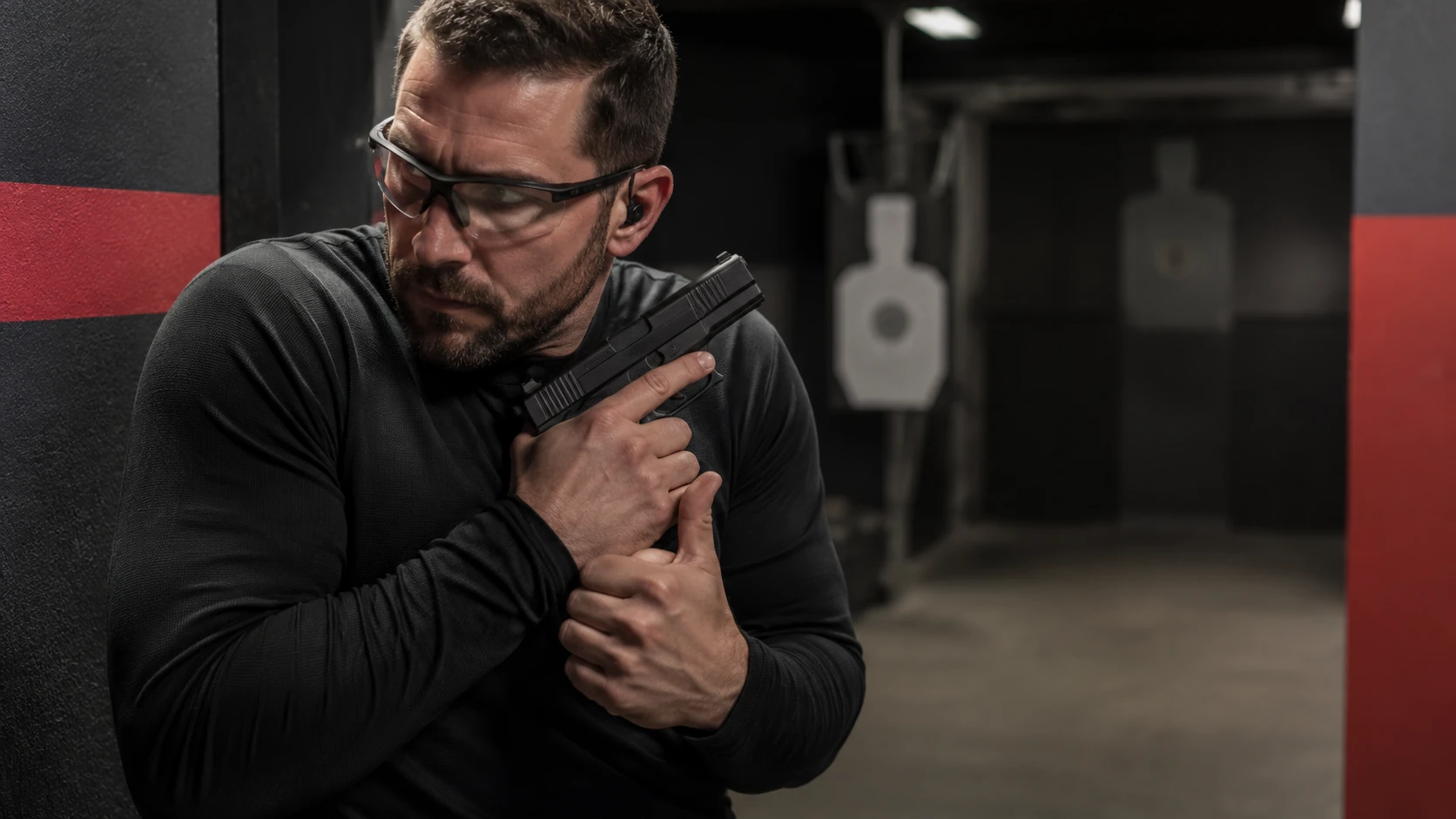
What Is the C.A.R. Center Axis Relock System?
The history, characteristics, advantages and limitations of Center Axis Relock, including the difference between the system and its film portrayal.
Center Axis Relock, usually shortened to C.A.R., is a close-quarter defensive system associated with weapon retention, compact body mechanics and rapid alignment. The original article explained the background of its creator Paul Castle, the work of successor Jeff Johnsgaard, the evolution into 360-degree Close Quarter Defense and the popular connection with the John Wick films.
The system is often reduced online to a distinctive sideways-looking pistol pose. That is incomplete. C.A.R. is intended as an integrated method involving body orientation, weapon-side and reaction-side roles, retention, movement, transitions and defensive actions.
This article preserves the original historical account, ten claimed benefits, five drawbacks and course topics while adding an important qualification: no stance is universally best. Its value depends on context, lawful purpose, instruction and the ability to transition to conventional shooting positions.
- Paul Castle developed C.A.R. from his law-enforcement, protection and training experience.
- Jeff Johnsgaard was named Castle successor and continued the system through 360-degree Close Quarter Defense.
- The system keeps the firearm closer to the body and divides tasks between a weapon side and reaction side.
- The John Wick presentation is visually influenced by C.A.R. but is not a complete representation of the system.
- C.A.R. can be useful in specific close-quarter problems but requires qualified instruction and should complement, not replace, conventional fundamentals.
Paul Castle and the origin of the system
Paul Castle was a British law-enforcement and tactical-training professional with decades of operational and instructional experience. The original article described work in investigation, counter-terrorism support, close protection, officer survival, specialist entry and firearms instruction.
His training background included UK and international law-enforcement and military audiences. He authored numerous programmes and became best known for developing Center Axis Relock as an approach to close-quarter firearm control and survival.
The central idea was not to create a visually unusual stance. It was to use natural body structure, compact weapon placement and coordinated defensive movement when conventional full extension may be difficult or unsafe.
Jeff Johnsgaard and 360-degree Close Quarter Defense
In 2009 Paul Castle named Jeff Johnsgaard as his official successor. After Castle death in 2011, Johnsgaard continued teaching and refining the material rather than treating the system as a fixed set of poses.
The later 360-degree Close Quarter Defense framework combines firearms, physical skills, learning methodology and defensive problem-solving. The original article also noted Johnsgaard international teaching work and annual instructor-development activity.
Bartosz learned the system through instructor Valerio Lino of Veritas Tactical in Brazil. That lineage matters because the method is difficult to understand accurately from film clips or photographs alone.
Core characteristics of Center Axis Relock
C.A.R. is designed for close distances where retention, balance and mobility may matter more than maximum sight radius. The firearm can be held nearer the centre line of the body, reducing the amount of weapon projected toward another person.
The body is organised into a weapon side and a reaction side. The reaction side can protect, frame, block or assist, while the weapon side maintains control. The method also attempts to use body weight and skeletal support rather than relying only on muscular tension.
Because the body orientation remains compact, the same general structure can support transitions between empty-hand actions, OC spray, handgun and, in some applications, a long gun. This is one reason the system is taught as a broader close-quarter method rather than a single pistol technique.
The connection with John Wick
The John Wick films made a compact, centre-line pistol presentation recognisable to a much wider audience. The choreography uses positions that resemble C.A.R., especially the close placement of the handgun and the strong visual alignment of the pistol with the eyes.
Film techniques are selected for storytelling, camera visibility and movement. They are not a complete training syllabus, and the movements shown on screen should not be copied without instruction.
The real system includes safety, retention, transitions, reaction-side work, movement and decision-making. A two-second film pose cannot show the context that determines when a compact position is appropriate and when the shooter should extend or use another position.
Ten reasons practitioners value the system
- Weapon retention. The firearm remains closer to the body and may be harder for another person to seize.
- Compact operation. The position can be used where full arm extension is restricted.
- Natural eye alignment. Correct body orientation can bring the sights or slide into the dominant-eye line quickly.
- Reaction-side availability. The non-weapon side can protect, block, create space or assist with control.
- Structural support. The method seeks to use skeletal alignment and balanced muscle engagement.
- Reduced fatigue. A compact supported position may be easier to maintain than an unsupported extended arm in some situations.
- Transitions. The system provides a common body framework for moving between different tools.
- Mobility. The body can remain relatively balanced while changing direction.
- Close-quarter orientation. It gives students a structured answer to distances where conventional extension may not fit.
- Defensive integration. Firearm handling is connected with physical protection rather than treated as an isolated range skill.
Five limitations and common criticisms
- Reduced capability at distance. Compact positions do not replace a stable conventional presentation for many longer-range or precision tasks.
- Unfamiliar visual alignment. Students may initially struggle with the eye, head and pistol relationship.
- Risk of imitation without context. Copying the film appearance can create unsafe muzzle direction or poor mechanics.
- Training requirement. The method needs coached repetition, transitions and pressure testing; it is not learned from a photograph.
- Context dependence. Body shape, mobility, equipment, environment and lawful role all affect whether a technique is suitable.
Subjects included in a C.A.R. programme
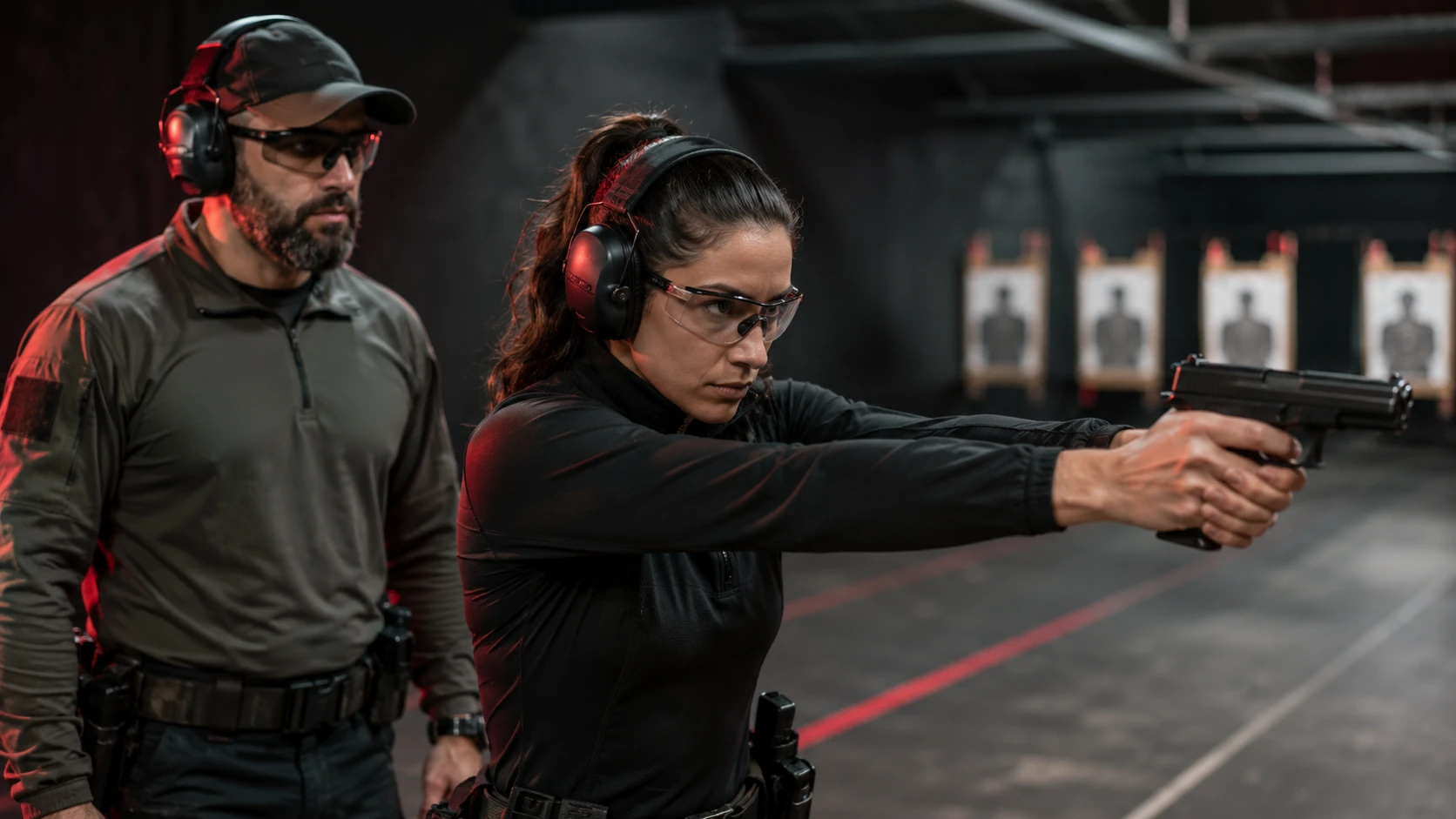
A responsible introduction begins with safety, firearm handling and the purpose of each position. Students learn the basic body orientation, weapon-side and reaction-side roles, visual alignment and transitions into and out of conventional positions.
Training can then add movement, retention concepts, reloads, use around confined spaces, low-light considerations and integration with protective actions. The precise content depends on student level and the legal, professional or civilian context.
Students must already have safe pistol fundamentals. The system does not remove the need for muzzle awareness, trigger discipline, correct loading and unloading or accurate conventional shooting.
- Safety and close-quarter muzzle management.
- Basic C.A.R. positions and the reason for each one.
- Eye alignment, body angle and controlled presentation.
- Weapon-side and reaction-side coordination.
- Transitions to conventional two-handed shooting.
- Movement, confined-space use and appropriate scenario work.
Is Center Axis Relock worth learning?
It is worth learning when the student has reliable fundamentals, receives qualified instruction and understands the close-quarter problems the system is trying to solve. It can add retention, compactness and alternative body mechanics to an existing skill set.
It is not a replacement for conventional marksmanship, nor is it automatically superior because it looks dynamic. A capable practitioner should be able to move between compact, extended, one-handed and supported positions according to distance and environment.
The most productive approach is to test the system honestly in controlled training, keep the parts that solve real problems and avoid treating any single method as the answer to every situation.
C.A.R. is a specialised close-quarter framework
Center Axis Relock has a documented training lineage and a broader structure than its film image suggests. Its strongest contribution is the integration of compact firearm control with retention, movement and reaction-side action.
Students should learn it from qualified instructors, maintain conventional fundamentals and evaluate it as one tool within a complete defensive skill set.